You rock your baby for twenty minutes, lower her toward the crib as slowly as your arms allow, and her eyes open before your hands leave the mattress.
When a baby cries when put down, it is natural to assume the crib, your technique, or the clock is to blame.
The timing often tells a different story, because the tears tend to start at the moment the contact ends.
Knowing what that handoff feels like from a baby's side gives you something better than trial and error to work with.
Why Does My Baby Cry When Put Down?
A baby may cry when put down because they miss physical contact, react to a sudden change in position, wake during the move to the crib, or feel physical discomfort.
Often more than one of these overlaps, which is why the same baby can settle easily one night and protest the next.
Getting better at reading your baby’s cries overall can help you spot which one is happening tonight.
Your Baby Wants Physical Closeness
In your arms, your baby feels your warmth, hears your heartbeat, and moves whenever you do. A flat mattress offers none of that, so the shift can feel sudden.
MedlinePlus, the health resource from the National Library of Medicine, lists your voice, heartbeat, skin, scent, and movement as familiar sensations that can soothe an infant.
When the crying starts at the handoff, your baby may be asking for those comforts back.
The Moro Reflex Makes Babies Startle
The Moro reflex, also called the startle reflex, is an involuntary response present in newborns.
According to MedlinePlus, babies often extend their arms, then pull them in with a brief cry when startled by a loud sound or sudden movement.
Lowering a baby toward a mattress can feel like a drop, which may trigger the reflex and interrupt settling. This reflex fades over the first few months.
Your Baby Wakes During the Sleep Transfer
Newborns move between active sleep and quiet sleep, and lighter stretches may make it easier for a change in position, temperature, or surroundings to wake them.
If a baby drifts off in your arms and is moved right away, the transfer can land during one of those lighter stretches, and the baby wakes fully.
Waiting until your baby's body feels relaxed before lowering them may reduce the odds of waking, although no method works every time.
Hunger, Gas, or Other Discomfort
Hunger, trapped gas, a wet diaper, or a room that is too warm or too cold can make lying down unpleasant, and MedlinePlus lists each among the usual reasons infants cry.
Gas can be stubborn, so it helps to know what to try when a baby won't burp after feeding.
Congestion or other discomfort may also feel worse once a baby is flat, so check these before assuming the crying is about contact.
These reasons can apply at any age, but newborns feel the gap between arms and mattress most. That makes the early weeks the best place to sort out what is typical.
Newborn Cries When Put Down: What Is Normal?

It is common for newborns to cry when put down because they are still adjusting to their surroundings and rely heavily on physical closeness for comfort.
Parents commonly notice this in the first weeks, and it often reflects a baby’s needs, not a problem with the baby or the parent.
Crying is a newborn’s main way of communicating, which is part of why babies cry so much in the early weeks.
Life outside the womb is brighter and cooler, so being held is the closest match to the snug, moving place your baby knew before birth.
Frequent crying at the handoff does not mean your baby is spoiled.
The CDC states that you will not spoil your baby by holding or responding to them, and NHS maternity guidance says the same.
As babies grow, their reactions change.
Some settle into a crib more easily over time, while others protest more around sleep changes, and a guide to baby sleep regression stages covers how those phases tend to look.
No fixed age marks the end of this phase.
Typical or not, crying at every handoff wears parents down. A few small changes can make the transfer smoother while keeping sleep safe.
How Can You Help a Baby Who Cries Every Time You Put Down?
No single step works for every baby, so it can help to try them in order and adjust.
Check Your Baby's Basic Needs First
Before the handoff, feed, burp, and change your baby so avoidable discomfort is already handled.
Check the room too, since the CDC lists sweating or a hot-feeling chest as signs a baby may be too warm.
A quick scan for a stuffy nose or other signs of discomfort rounds out the check.
Try a Gentle Sleep Transfer
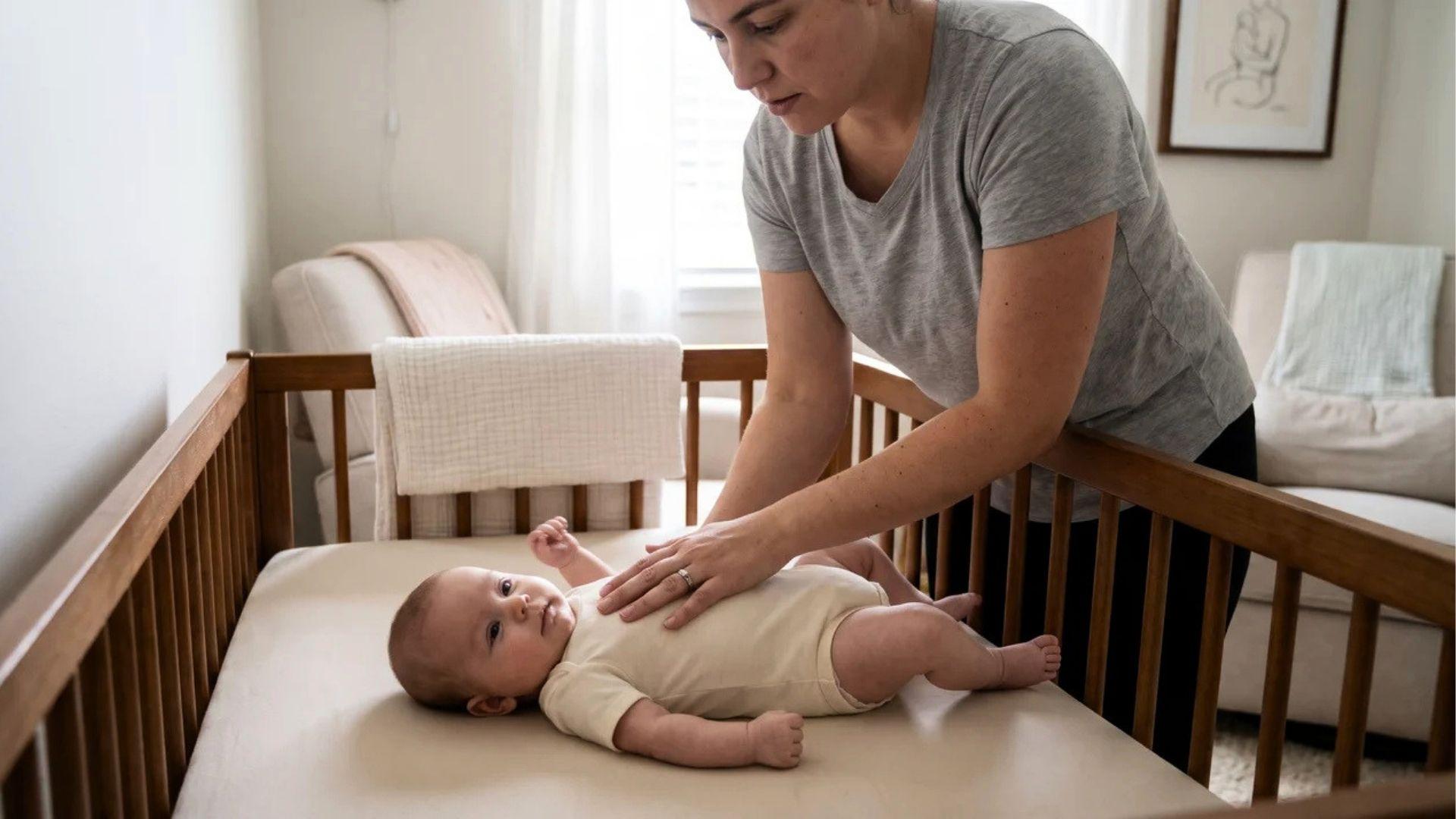
Lower your baby slowly while keeping them close to your body, and keep your arms in contact for a moment after they reach the mattress.
A hand on the chest or tummy and a soft voice can make the shift feel gradual. If your baby stirs, a few seconds of gentle patting or rocking may settle them before you step back.
With practice, the sequence often feels smoother for both of you.
Use Age-Appropriate Soothing Techniques
Supervised babywearing while your baby is awake, gentle rocking, and soothing sounds such as humming or a fan can calm a fussy baby, according to MedlinePlus.
In any carrier, keep your baby's face visible and uncovered. Swaddling is an option for young babies, but only until they show signs of rolling.
The American Academy of Pediatrics advises stopping swaddling as soon as a baby shows any sign of trying to roll over.
Some babies start working on rolling as early as 2 months, so watch for rolling signs rather than relying on age alone.
Follow Safe Sleep Practices Every Time
No soothing method replaces safe sleep.
The NICHD Safe to Sleep guidance and the CDC agree on the core rules for naps and nighttime:
- Place your baby on their back for every sleep.
- Use a firm, flat, level surface, such as a crib or bassinet mattress covered by a fitted sheet.
- Keep the sleep area clear of pillows, blankets, bumpers, and soft toys.
Swings, bouncers, and inclined seats do not count as safe sleep surfaces.
The Consumer Product Safety Commission advises moving a baby who falls asleep in one to a firm, flat sleep space as soon as possible.
A swaddled baby also belongs on their back, since swaddled babies can have trouble moving out of a stomach or side position.
Much of this crying may ease once the basics are covered. A few patterns point somewhere else, and those need a different response.
When Should You Worry About Crying When Your Baby Is Put Down?

Crying when put down is often ordinary, but a sudden change in crying or other symptoms alongside it is a reason to contact a healthcare provider.
Parents know their baby's usual patterns best, and a sense that something is off is a fair reason to call.
Persistent crying together with feeding difficulty, vomiting, unusual sleepiness, or signs of pain deserves a call to your baby's doctor.
Crying mainly when lying flat, particularly alongside other symptoms, should not be dismissed as a bid for attention, and a provider can look into possible causes.
The NHS urgent medical help guidance lists signs that need urgent care for babies, including:
- Difficulty breathing, such as fast or labored breathing, grunting, or pauses in breathing
- Blue, grey, pale, or blotchy skin, lips, or tongue
- Being difficult to wake, unusually sleepy, or not responding as usual
- A temperature of 38°C (100.4°F) or higher in a baby under 3 months old
Contact a healthcare provider or emergency services right away if you see any of these.
Questions about what is typical for your own baby are best taken to your pediatrician, who knows their history.
Closeness Is Often the Message Behind the Crying
When a baby cries when put down, the crying is often a message about contact, comfort, or timing rather than a verdict on your parenting.
One useful habit is to treat each handoff as a small experiment: change one thing, such as the burping, the pace of the lowering, or the pause before you let go, and watch what shifts.
Those small notes can reveal a pattern faster than general advice. Tonight, pick one change from this guide, keep sleep safe, and see how your baby responds.
Frequently Asked Questions
Can a Pacifier Help a Baby Who Cries When Put Down?
A pacifier helps some babies settle. NICHD suggests parents think about offering one for naps and bedtime, as long as it is never attached to a string, clothing, or toy.
Is It Okay to Let My Baby Cry for a Few Minutes if I Need a Break?
If crying is wearing you down, place your baby on their back in a crib or bassinet, step away briefly, and check on them every 5 to 10 minutes, as the CDC advises.
Can My Baby Sleep on My Chest Instead of in a Crib?
Holding your baby on your chest while you are alert is fine. For sleep, the CDC and NICHD recommend a separate firm, flat surface, so move your baby there if you feel yourself dozing off.
Can I Put My Baby Down on Their Tummy While They Are Awake?
Yes, tummy time while your baby is awake is encouraged because it supports muscle strength and motor skills. An adult should stay with them the whole time.